When I first read about J. Anderson's new theory of diving by zero, I was skeptical. There are numerous algebraic tricks one can play to make zero-division work out, and I would be surprised to see a novel approach to this problem so late in the game. After seeing the details of the "theory", I knew it was garbage, and suspected that it had already been dissected by M. Chu-Carroll at Good Math, Bad Math; lo and behold, it had.
In true ScienceBlogs form, Chu-Carroll pumps much more vitriol into his response than I would have. Rather than pushing my bile to the surface, it simply makes me wonder why Anderson would make such a foolhardy public display of his "discovery" without first consulting a working mathematician. England has no shortage of universities; they can't all be inaccessible from Berkshire.
Friday, December 08, 2006


Wednesday, December 06, 2006
Another shot at the travelling salesman problem
H. Kleiman has written a (very short) paper in which he claims to have proven that P=NP. Many of the usual red flags are up; e.g., his article is only available as a pdf (i.e., he provides no LaTeX source) and the references are light. On the other hand, he withholds the usual bluster with which such claims are made, instead using language like "we (hopefully) can always obtain an optimal tour in M(a) in polynomial time" and "[i]f the algorithm has no errors, ... P=NP." Time will tell...
Tuesday, December 05, 2006
SECANTS RATE highly in my book
Longtime readers already know that I'm a regular visitor to dieselsweeties.com to get the daily comic by R. Stevens (or rstevens, as he prefers) featuring the inimitable Clango Cyclotron. He really should visit LBL at some point and see some of the ARCANE TESTS they carry out with the 88". You know, Clango could get in touch with his roots; after all, that first 'L' stands for Lawrence, the inventor of the cyclotron.
I'm enough of a fan of DS that I got my lovely wife a t-shirt featuring a punchline from the comic for Christmas last year. Being a mammalogist, this is far and away the most appropriate of the DS shirts for her to wear, although our CAT RESENTS A message so positive about another species.

I get the impression that R. Stevens is a cat person (and Mac user) like me; given the opportunity, I would CARESS TEN, AT least.
A wish of mine has been granted, and some recent Diesel Sweeties strips have featured mathematically-themed humor. It's good to see that R. Stevens RECASTS A NET from time to time to trawl for these sorts of jokes. The second, in addition to referencing one of the great integer sequences, is concerned with puns, which mathematicians inexplicably enjoy more than most other people. Some mathematicians also enjoy anagrams, although that's more easily explained by the fact that they are a special case of permutations.
Tocelebrate cope with the commerce season, Stevens is running an anagrammatically named contest. He's a rather good sport about it, even suggesting that writers might describe his pants as a one-ACRE ASS TENT. If I were to open myself up to such public conversation, I'd feel like an ANT AT RECESS, leaving myself completely at the whim of schoolkids. I like his output too much to be so cruel; I especially enjoy Maura's antics (A TART'S SCENE if ever there was one) and the strips in which A SCAT ENTERS. I usually detest "bio-humor", but somehow Stevens treats it so absurdly that it has a certain appeal.
Here's wishing R. Stevens, Clango, and the whole Diesel Sweeties crew a Merry Present Season and a Happy New Year!
I'm enough of a fan of DS that I got my lovely wife a t-shirt featuring a punchline from the comic for Christmas last year. Being a mammalogist, this is far and away the most appropriate of the DS shirts for her to wear, although our CAT RESENTS A message so positive about another species.

I get the impression that R. Stevens is a cat person (and Mac user) like me; given the opportunity, I would CARESS TEN, AT least.
A wish of mine has been granted, and some recent Diesel Sweeties strips have featured mathematically-themed humor. It's good to see that R. Stevens RECASTS A NET from time to time to trawl for these sorts of jokes. The second, in addition to referencing one of the great integer sequences, is concerned with puns, which mathematicians inexplicably enjoy more than most other people. Some mathematicians also enjoy anagrams, although that's more easily explained by the fact that they are a special case of permutations.
To
Here's wishing R. Stevens, Clango, and the whole Diesel Sweeties crew a Merry Present Season and a Happy New Year!
Thursday, November 30, 2006
Elucidating low technology
All manner of news outlets are reporting on the just announced unraveling of the heretofore mysterious Antikythera mechanism, rediscovered over 100 years ago after falling to the bottom of the Sea of Crete nearly 2000 years before that. Network World has a few photos of the X-ray and tomographic technicians at work, and Wired has put up some beautiful pictures of the device produced from Hewlett-Packard's gallery of reflectance images, in which the user can control how the object is lit. Especially interesting are the fragments of documentation etched into the works, although I must say, it's all Greek to me.
As long-time readers know, I have a soft spot for collisions between the old and the new. It's rather appealing to see the advances in imaging technology over the past century reverse the effects of the elements grinding away for millennia. Consider how lucky we are that it was recovered late enough in history that non-destructive methods were used to study it; it's not too hard to imagine a Victorian-era engineer attempting to take it apart or washing it with baking soda and vinegar.
Having recently read Guns, Germs, and Steel, I can't help but be reminded of the Phaistos disk, another artifact illustrating that Cretan technology was far ahead of its time. It would seem that in both cases the adaptive advantage offered by adopting the new technology (in the case of Phaistos, movable type; in the case of Antikythera, geared wheels) was insufficient to merit the labor required to implement them. The criteria for an innovative idea to be "good" depends on context much more than many people realize.
As long-time readers know, I have a soft spot for collisions between the old and the new. It's rather appealing to see the advances in imaging technology over the past century reverse the effects of the elements grinding away for millennia. Consider how lucky we are that it was recovered late enough in history that non-destructive methods were used to study it; it's not too hard to imagine a Victorian-era engineer attempting to take it apart or washing it with baking soda and vinegar.
Having recently read Guns, Germs, and Steel, I can't help but be reminded of the Phaistos disk, another artifact illustrating that Cretan technology was far ahead of its time. It would seem that in both cases the adaptive advantage offered by adopting the new technology (in the case of Phaistos, movable type; in the case of Antikythera, geared wheels) was insufficient to merit the labor required to implement them. The criteria for an innovative idea to be "good" depends on context much more than many people realize.
Monday, November 27, 2006
The other half
Appropriately enough, on the day that I filed my dissertation, a paper went up completing my work on characterizing B2-crystals by local criteria. It's great to see this, since my article proved only half of the desired result. As I said before, it's good to have publicly visible work; if I didn't, I would not have been given due acknowledgment both in the references and the introduction.
Especially exciting is the possibility that the approach taken by V. I. Danilov, A. V. Karzanov, and G. A. Koshevoy might be generalizable to bigger algebras, so we might see a local characterization of G2-crystals sometime next year!
Especially exciting is the possibility that the approach taken by V. I. Danilov, A. V. Karzanov, and G. A. Koshevoy might be generalizable to bigger algebras, so we might see a local characterization of G2-crystals sometime next year!
Wednesday, November 22, 2006
Ph.inally D.one
There's another F-word that I could have used to title this post, but I know that some of my readership prefer more Ph.amily-Ph.riendly language.
It's hard to get a Ph.D., and not just in the sense that a lot of work goes into the coursework, finding a topic, making an original contribution to the field, etc. After it seems that everything is done; after all 130 pages have been edited, re-edited, and verified by three committee members; after it's been printed on at least 20# paper with at least 25% cotton content; after the cover sheet has been signed by all three members (one of whom is in Australia, another of whom is now in Paris); after two additional copies of the abstract (without page numbers) have been printed; the work isn't done. There are two anonymous questionnaires, one from the NSF and one from UC Davis; there is a release form authorizing the powers that be to copy the document that I spent the last four years preparing onto microfilm and bind it in the library; there is an appointment (between the hours of 1:00 and 4:00 on Tuesday) to be made with one of the staff in the office of graduate studies, wherein the above forms are put in order to be passed on the appropriate offices, and every page of my dissertation is examined to ensure that the pages are consecutive, as are the chapters, and the sections, and the subsections, and that my font is suficiently large and uniform throughout, and that the margins are respected (god forbid you disrespect the margins!). Frankly, if this kind of administrative scrutiny was demanded of bachelors recipients, the numbers for that degree would be much lower. But if you can make it through all of that, then you will have satisfied all requirements of the degree of Doctor of Philosophy, and I'm proud to report that I have done precisely that.
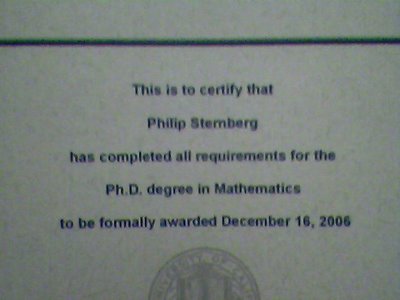
I was somewhat surprised by my elation when D. Swindall handed me that certificate. For many months now, when asked how far along I was, I've said something like "It's mostly paperwork at this point," or "I just have some administrative details to take care of," or "I'm down to minor editing." After saying such a white lie so many times I started to believe that the work I had left really was negligible, and that, for all intents and purposes, I was done. I had even walked; how much could that feeling of completion be enhanced by mere paperwork?
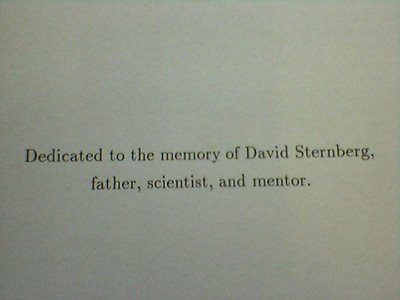
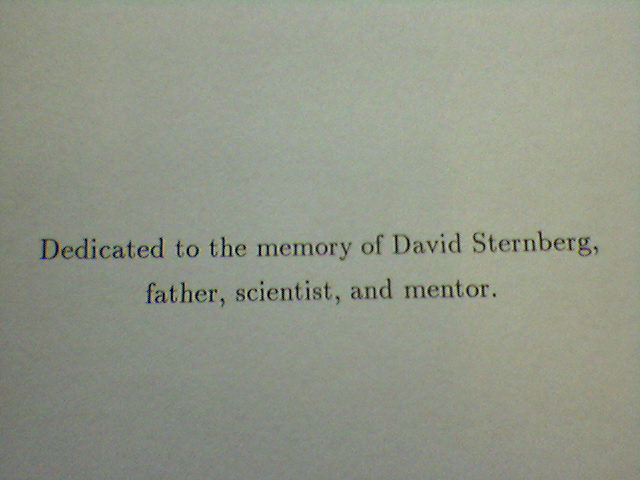
A whole lot, as it turns out. After spending those fifteen minutes yesterday witnessing the inspection of my dissertation's pages, I could say, for the first time without qualification, that I am Dr. Philip Max Sternberg. I'm now as educated as my wife, (although the jury's still out as to who's the smarter one). I'm also the second Dr. Sternberg in my family, a tradition that my father would be happy to see me carry on. Of course, in his view, the important aspect of this endeavor is scholarship, not the title; I'm glad to have had him instill me with that sense of values. For this, and many other reasons, I'm extremely grateful to have the opportunity to dedicate my dissertation to his memory.
Yesterday marked the end of this stage of my life in another way, too; my Jetta, my first car, my graduation present, the car that carried me through all of grad school, was sold to a young couple, both of whom just started their graduate studies. It served me well, and was with me for many fond memories. But it was time to let it go. I think it was best to have it pass out of my hands at the same time as my dissertation; the sense of completion and finality is made all the more real because of it.
A big day, in so many ways.
It's hard to get a Ph.D., and not just in the sense that a lot of work goes into the coursework, finding a topic, making an original contribution to the field, etc. After it seems that everything is done; after all 130 pages have been edited, re-edited, and verified by three committee members; after it's been printed on at least 20# paper with at least 25% cotton content; after the cover sheet has been signed by all three members (one of whom is in Australia, another of whom is now in Paris); after two additional copies of the abstract (without page numbers) have been printed; the work isn't done. There are two anonymous questionnaires, one from the NSF and one from UC Davis; there is a release form authorizing the powers that be to copy the document that I spent the last four years preparing onto microfilm and bind it in the library; there is an appointment (between the hours of 1:00 and 4:00 on Tuesday) to be made with one of the staff in the office of graduate studies, wherein the above forms are put in order to be passed on the appropriate offices, and every page of my dissertation is examined to ensure that the pages are consecutive, as are the chapters, and the sections, and the subsections, and that my font is suficiently large and uniform throughout, and that the margins are respected (god forbid you disrespect the margins!). Frankly, if this kind of administrative scrutiny was demanded of bachelors recipients, the numbers for that degree would be much lower. But if you can make it through all of that, then you will have satisfied all requirements of the degree of Doctor of Philosophy, and I'm proud to report that I have done precisely that.
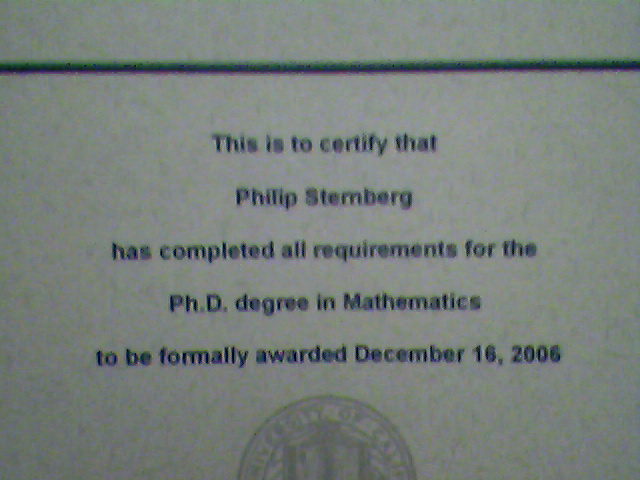
I was somewhat surprised by my elation when D. Swindall handed me that certificate. For many months now, when asked how far along I was, I've said something like "It's mostly paperwork at this point," or "I just have some administrative details to take care of," or "I'm down to minor editing." After saying such a white lie so many times I started to believe that the work I had left really was negligible, and that, for all intents and purposes, I was done. I had even walked; how much could that feeling of completion be enhanced by mere paperwork?
A whole lot, as it turns out. After spending those fifteen minutes yesterday witnessing the inspection of my dissertation's pages, I could say, for the first time without qualification, that I am Dr. Philip Max Sternberg. I'm now as educated as my wife, (although the jury's still out as to who's the smarter one). I'm also the second Dr. Sternberg in my family, a tradition that my father would be happy to see me carry on. Of course, in his view, the important aspect of this endeavor is scholarship, not the title; I'm glad to have had him instill me with that sense of values. For this, and many other reasons, I'm extremely grateful to have the opportunity to dedicate my dissertation to his memory.
Yesterday marked the end of this stage of my life in another way, too; my Jetta, my first car, my graduation present, the car that carried me through all of grad school, was sold to a young couple, both of whom just started their graduate studies. It served me well, and was with me for many fond memories. But it was time to let it go. I think it was best to have it pass out of my hands at the same time as my dissertation; the sense of completion and finality is made all the more real because of it.
A big day, in so many ways.
Tuesday, November 21, 2006

Friday, November 17, 2006
Return fire!
M. Diaby claims to have invalidated R. Hofman's refutation of his purported proof of P=NP that was discussed earlier. It's not so much an article as an invitation to a public shouting match, seeing as it lacks an abstract, or references, or even self-contained expository prose. I hope Hofman responds again; this could get interesting.
Thursday, November 16, 2006
What's a four-letter word starting with "R" for "Computer technology developed by D. Patterson"?
It all depends on your interests: if data storage is your thing, the answer is RAID; if you like compilers and microprocessor architecture, you're probably looking for RISC. If, on the other hand, you're taken by what the future might hold for parallel computing, the correct acronym is RAMP; Research Accelerator for Multiple Processors. If you want to continue to be impressed, look over the short version of D. Patterson's biography; he also has a slightly longer version, illustrating that impressiveness can scale linearly.
I had the great pleasure to attend Patterson's talk at PARC a week ago on the view from Berkeley. I strongly encourage you to watch the video linked from the above page or look over the accompanying slides; in them the audience is treated to the old and new conventional wisdoms on processor design, an explanation of the sudden π-turn the industry has made regarding parallelism, and visions of a future with 1000's of processors (or cores, as some call them) on a single chip; this scenario (termed "many-core" by Patterson) is a far cry from the so-called "multi-core" chips emerging on the market right now.
This is good news for the computational science community; for one thing, it means that we're not going to run into the "brick wall" of power consumption, memory accessibility, and instruction-level parallelism, so scientific applications will continue their exponential march toward ever-greater computational power. For another, it means there's plenty of work to be done in adapting the fundamental algorithms behind the computational work that goes on these days.
And what does it mean for the general, non-scientific computer-using population? At first, it may seem that computers are fast enough, hard drives large enough, etc., for most of what anyone could ever need. However, all it takes is some ingenuity to put all that power to good use; another great example of this sort of imagination was already discussed. If you've ever edited photos, audio, or video, or waited an hour to extract the music from a CD, you've wanted the power that many-core processors may be able to deliver. When asked "How fast is fast enough?", L. Ellison said "In the blink of an eye." We clearly have a long way to go before the current generation of applications meet that standard; hopefully, many-core technology will carry us a long way along that road.
I had the great pleasure to attend Patterson's talk at PARC a week ago on the view from Berkeley. I strongly encourage you to watch the video linked from the above page or look over the accompanying slides; in them the audience is treated to the old and new conventional wisdoms on processor design, an explanation of the sudden π-turn the industry has made regarding parallelism, and visions of a future with 1000's of processors (or cores, as some call them) on a single chip; this scenario (termed "many-core" by Patterson) is a far cry from the so-called "multi-core" chips emerging on the market right now.
This is good news for the computational science community; for one thing, it means that we're not going to run into the "brick wall" of power consumption, memory accessibility, and instruction-level parallelism, so scientific applications will continue their exponential march toward ever-greater computational power. For another, it means there's plenty of work to be done in adapting the fundamental algorithms behind the computational work that goes on these days.
And what does it mean for the general, non-scientific computer-using population? At first, it may seem that computers are fast enough, hard drives large enough, etc., for most of what anyone could ever need. However, all it takes is some ingenuity to put all that power to good use; another great example of this sort of imagination was already discussed. If you've ever edited photos, audio, or video, or waited an hour to extract the music from a CD, you've wanted the power that many-core processors may be able to deliver. When asked "How fast is fast enough?", L. Ellison said "In the blink of an eye." We clearly have a long way to go before the current generation of applications meet that standard; hopefully, many-core technology will carry us a long way along that road.
Wednesday, November 08, 2006
Get your hands on some games
One of the most common expository metaphors of discrete mathematics is "playing a game". Sometimes this is taken quite literally, as with the algebro-geometric algorithm jeu de taquin, the enumerative object named for an 8-bit Nintendo game, and the patience sorting algorithm, which American audiences might prefer to call the Klondike sorting algorithm. It shouldn't be surprising that some discrete games have been a rich source of interesting mathematical questions, and that a certain game with a long history still poses academic challenges.
And speaking of games, an excellent source of casual games is J. Bibby's site Jay is Games. I discussed one of their recommended games earlier, although I came across it independently of JiG.
In Planarity, I often have planarized a subset of the vertices and want to move them all at once. If only the interface would let me manipulate more than one vertex at a time! J. Han has put together a device implementing a multi-touch interface in his lab at the Courant Institute; in addition to running silly graph-theoretic games, it augurs what may very well be the next paradigm in human-computer interaction. In case the video on that page isn't enough to make you covet the tenth-generation iMac, take a look at this live demo. He mentions while illustrating the "puppet" application that cutting-edge mathematics and computational science make those dancing drawings possible. We are finally reaching the stage where the massive computational power sitting on the desktop can be harnessed to make computers behave in a way that is convenient to us, rather than the other way around. This is true innovation.
And speaking of games, an excellent source of casual games is J. Bibby's site Jay is Games. I discussed one of their recommended games earlier, although I came across it independently of JiG.
In Planarity, I often have planarized a subset of the vertices and want to move them all at once. If only the interface would let me manipulate more than one vertex at a time! J. Han has put together a device implementing a multi-touch interface in his lab at the Courant Institute; in addition to running silly graph-theoretic games, it augurs what may very well be the next paradigm in human-computer interaction. In case the video on that page isn't enough to make you covet the tenth-generation iMac, take a look at this live demo. He mentions while illustrating the "puppet" application that cutting-edge mathematics and computational science make those dancing drawings possible. We are finally reaching the stage where the massive computational power sitting on the desktop can be harnessed to make computers behave in a way that is convenient to us, rather than the other way around. This is true innovation.
Monday, November 06, 2006
Bucking the trend
As the title of my dissertation indicates, I've done research on crystals. Most non-mathematicians think that crystals refer to three-dimensional polytopes with evident symmetries; I've had to tell many a suddenly eager listener that what they call polyhedra are not the topic of my work. There is a path between crystals and polytopes, but it makes a lengthy journey through Lie theory and algebraic geometry (sometimes with a tropical substition), which makes even my head spin.
One reason I suspect that so many educated people feels a certain comfort with 3-polytopes is their diagrammatic use in chemistry. I know I have a fondness for my days spent at a lab bench playing with wooden balls and springs, building crude models for carbon rings and water molecules; I'm sure I'm not the only one with this sentiment.
Geodesic domes are a famous family of polytopes, closely related to buckyballs, named for the man responsible for bringing these structures into the public eye. Not only are they good for housing humans, they can also deliver microscopic payloads when its vertices are atoms and its edges are bonds between them; its facets will be pentagons and hexagons, thanks to the chemical nature of carbon. Generally the pentagons in these nano-scale buckyballs (also called fullerenes) must not be adjacent, as is the case for your garden variety soccer ball. However, a team of chemists (including some at my alma mater) have found an ovoid counterexample.
It seems the motivating application is to get heavy molecules such as triterbium nitride to slip into the human body undetected by encasing them in a carbon cage; we therefore have discreet metals thanks to discrete geometry!
One reason I suspect that so many educated people feels a certain comfort with 3-polytopes is their diagrammatic use in chemistry. I know I have a fondness for my days spent at a lab bench playing with wooden balls and springs, building crude models for carbon rings and water molecules; I'm sure I'm not the only one with this sentiment.
Geodesic domes are a famous family of polytopes, closely related to buckyballs, named for the man responsible for bringing these structures into the public eye. Not only are they good for housing humans, they can also deliver microscopic payloads when its vertices are atoms and its edges are bonds between them; its facets will be pentagons and hexagons, thanks to the chemical nature of carbon. Generally the pentagons in these nano-scale buckyballs (also called fullerenes) must not be adjacent, as is the case for your garden variety soccer ball. However, a team of chemists (including some at my alma mater) have found an ovoid counterexample.
It seems the motivating application is to get heavy molecules such as triterbium nitride to slip into the human body undetected by encasing them in a carbon cage; we therefore have discreet metals thanks to discrete geometry!
Thursday, November 02, 2006
num·ber: a musical selection
A. Gelfand (any relation to I. Gelfand or S. Gelfand?) has written a pair of stories for Seed and Wired concerning R. Mahanthappa and his new cryptologically inspired album, Codebook. I highly recommend that you give it a listen; between Gelfand's articles, the label's site for the recording, and the artist's myspace page you can listen to most of the numbers on the CD.
I really appreciate his approach to mathematical composition. He describes his initial cipher of J. Coltrane's "Giant Steps" as "unplayable", specifically wishing to avoid "the appearance of random noise." Rather than leave the melody of "Frontburner" in its raw encrypted state, Mahanthappa "had to tweak his coded message until it could be classified as music."
Perhaps it's an overstatement to assert that it wasn't music before the "tweaks", but I'm sure that it's much better music on their account. It's refreshing to see serial elements used as a stimulus for creative expression rather than a programmatic straitjacket.
I really appreciate his approach to mathematical composition. He describes his initial cipher of J. Coltrane's "Giant Steps" as "unplayable", specifically wishing to avoid "the appearance of random noise." Rather than leave the melody of "Frontburner" in its raw encrypted state, Mahanthappa "had to tweak his coded message until it could be classified as music."
Perhaps it's an overstatement to assert that it wasn't music before the "tweaks", but I'm sure that it's much better music on their account. It's refreshing to see serial elements used as a stimulus for creative expression rather than a programmatic straitjacket.
Wednesday, November 01, 2006
Symptoms of withdrawal
When I first saw mention of a proof of the existence of a solution to the Navier-Stokes equations, I assumed that it had more in common with "proofs" of P=NP or the Riemann hypothesis. In fact, P. Smith had some keen original insights, even if the paper ultimately needed to be withdrawn. There is no shame in this, of course. As G. Kuperberg has illustrated with many examples posted next to his office door, quite capable mathematicians will from time to time push something out the door before it can stand on its own two feet; many of these errors are discovered when a colleague provides a counter-example to one of the central proofs of the article, which I would find considerably more embarrassing than discovering a "serious flaw" in antecedent peer-reviewed literature. Real shame lies in leaving papers up after their erroneousness has been plainly illustrated; as of this writing, this is true of those who wrote about the LP formulation of the TSP just a few weeks ago.
This became a sufficiently hot topic in theblogosphere community that Seed magazine ran a short write-up of the brief history of Smith's work and the comments made from as high up as P. Woit's site. Unfortunately, S. Ornes took the opportunity to sensationalize the matter, suggesting that these events "might ... give mathematicians of the future a strong incentive to be hyper-meticulous about their work", and "[p]erhaps [they] will have to reconsider posting their work on arXiv."
As if there isn't already sufficient incentive. The referee process is ponderous, and it is simply not in anyone's interest, least of all the researcher's, to submit rough work to peer-reviewed journals. Sloppy work will take even longer to make it to press, or possibly be rejected outright. In our "publish or perish" world, six extra months between publications can have a severe impact on a performance review; while on the job market, it can make the difference between being employed and not.
And no one I know will change their practice of submitting to (or defying) the arXiv. The Seed article suggests that many members of the mathematical community will fear the public scrutiny and response that developed in the wake of the Navier-Stokes paper and therefore reduce their use of the electronic pre-print service. The fact is that extremely few of us are doing such high profile work that it will result in attention beyond the regular readership of our subclassifications, and thus have nothing of the sort to fear. Events such as this, as much as they might make for exciting news stories, have a minimal impact on the day-to-day life of working mathematicians.
The mechanisms that I see at work are two-fold: first, the increasing speed of mathematical communication via the internet, and second, the volume of positive attention mathematics has garnered in recent years in the culture at large. We just happen to be looking at a point in history where these two phenomena have interacted more dramatically than they have before, causing an unprecedented event, the speculated impact of which has been tremendously overstated.
Fifty years ago, preprints were mailed to colleagues at remote institutions, journals played a critical role in the communication of new research, and conferences were one of the rare opportunities for intimate interaction between mathematicians from different regions. Now, journals are published both in print and online, almost every author either uses the arXiv or maintains a collection of their preprints on their own website, and email is routinely used to disseminate results or facilitate collaborations. Conferences, while still providing a unique opportunity to travel to exotic locales and spend some uninterrupted quality time with like-minded researchers, no longer play their critical role in discourse, as conference proceedings are made available electronically and air travel costs for one-on-one collaboration are at stupendous historical lows. The trend always has been to take advantage of new technologies whenever they might be useful; the arXiv will maintain its utility, and will therefore see no decline in its usage.
Thanks to movies, television, and the popular press, a larger segment of the population has taken an interest in mathematics than ever before. This means not only that laypeople are more likely to have a demand for news from the math world, but also that more specialists are willing to fulfill that demand (such as in this forum, solipsistic as it may be). The result is one that has been seen time and time again; once a critical mass of anonymous commentators has accrued, the signal will be overwhelmed by noise. It's very sad that in this case some of that noise took the form of personal criticism of Prof. Smith by non-mathematicians who have no experience with the process of mathematics.
We all make mistakes; those of us who live on the cutting edge make a lot of them. We catch most of them before sharing our work with the world, but a few slip through, are caught later, and rectified. It's far better to live by the pursuit of truth than the fear of error.
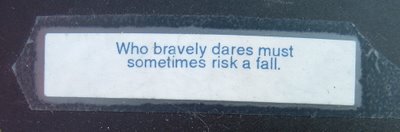
As a fortune I got after a chinese meal once told me:
This became a sufficiently hot topic in the
As if there isn't already sufficient incentive. The referee process is ponderous, and it is simply not in anyone's interest, least of all the researcher's, to submit rough work to peer-reviewed journals. Sloppy work will take even longer to make it to press, or possibly be rejected outright. In our "publish or perish" world, six extra months between publications can have a severe impact on a performance review; while on the job market, it can make the difference between being employed and not.
And no one I know will change their practice of submitting to (or defying) the arXiv. The Seed article suggests that many members of the mathematical community will fear the public scrutiny and response that developed in the wake of the Navier-Stokes paper and therefore reduce their use of the electronic pre-print service. The fact is that extremely few of us are doing such high profile work that it will result in attention beyond the regular readership of our subclassifications, and thus have nothing of the sort to fear. Events such as this, as much as they might make for exciting news stories, have a minimal impact on the day-to-day life of working mathematicians.
The mechanisms that I see at work are two-fold: first, the increasing speed of mathematical communication via the internet, and second, the volume of positive attention mathematics has garnered in recent years in the culture at large. We just happen to be looking at a point in history where these two phenomena have interacted more dramatically than they have before, causing an unprecedented event, the speculated impact of which has been tremendously overstated.
Fifty years ago, preprints were mailed to colleagues at remote institutions, journals played a critical role in the communication of new research, and conferences were one of the rare opportunities for intimate interaction between mathematicians from different regions. Now, journals are published both in print and online, almost every author either uses the arXiv or maintains a collection of their preprints on their own website, and email is routinely used to disseminate results or facilitate collaborations. Conferences, while still providing a unique opportunity to travel to exotic locales and spend some uninterrupted quality time with like-minded researchers, no longer play their critical role in discourse, as conference proceedings are made available electronically and air travel costs for one-on-one collaboration are at stupendous historical lows. The trend always has been to take advantage of new technologies whenever they might be useful; the arXiv will maintain its utility, and will therefore see no decline in its usage.
Thanks to movies, television, and the popular press, a larger segment of the population has taken an interest in mathematics than ever before. This means not only that laypeople are more likely to have a demand for news from the math world, but also that more specialists are willing to fulfill that demand (such as in this forum, solipsistic as it may be). The result is one that has been seen time and time again; once a critical mass of anonymous commentators has accrued, the signal will be overwhelmed by noise. It's very sad that in this case some of that noise took the form of personal criticism of Prof. Smith by non-mathematicians who have no experience with the process of mathematics.
We all make mistakes; those of us who live on the cutting edge make a lot of them. We catch most of them before sharing our work with the world, but a few slip through, are caught later, and rectified. It's far better to live by the pursuit of truth than the fear of error.
As a fortune I got after a chinese meal once told me:

Tuesday, October 31, 2006
Rather, it's been a big week for crystals
I mentioned some new results on crystals a short while ago; and today, there are two more. These are are of even greater interest to me, as they naturally follow my contribution to the program on perfect crystals.
The next step in M. Okado's research is to obtain an explicit description of type $D_n^{(1)}$-crystals. Since I have more experience dealing with such objects than just about anyone else, Okado-san has invited me to join him in Osaka to work on this problem. I'm not sure if I'll be able to make it, but the invitation certainly is tempting.
The next step in M. Okado's research is to obtain an explicit description of type $D_n^{(1)}$-crystals. Since I have more experience dealing with such objects than just about anyone else, Okado-san has invited me to join him in Osaka to work on this problem. I'm not sure if I'll be able to make it, but the invitation certainly is tempting.
Thursday, October 26, 2006
IP $\neq$ LP
And in case you might have heard otherwise, we still don't know about P and NP. There are some recently submitted papers (all of which are rather light on references) in the Computational Complexity section of the CS arXiv claiming that P and NP are the same thing, based on formulating the traveling salesman problem as a linear program. Of course, they all make the classic mistake of underestimating the importance of constraining the variables to be integers.
The traveling salesman problem (or the TSP, an abbreviation that reduces the running time of saying its name by a factor of 2) asks simply "What is the shortest journey that makes exactly one stop in every city on a list?" Lest you think this problem is hopelessly academic, peruse this description of a few of the applications of the TSP. And lest you think that this problem seems simple, consider that $1,000,000 rests on its resolution.
I suppose it's not too shocking that a glory-seeking Associate Professor and an unknown researcher (is he a graduate student? an employee of a call-center software company?) would throw their hats in the ring. Hopefully they will learn that integer programming (IP) is not the same thing as linear programming (LP).
Fortunately, R. Hofman has set the record straight. Now, will those other two fellows follow the directions for withdrawing a paper from the arXiv?
Update 11/3/2006: R. Hofman has composed a more general rebuttal to those authors that have used linear programming to claim that P=NP.
The traveling salesman problem (or the TSP, an abbreviation that reduces the running time of saying its name by a factor of 2) asks simply "What is the shortest journey that makes exactly one stop in every city on a list?" Lest you think this problem is hopelessly academic, peruse this description of a few of the applications of the TSP. And lest you think that this problem seems simple, consider that $1,000,000 rests on its resolution.
I suppose it's not too shocking that a glory-seeking Associate Professor and an unknown researcher (is he a graduate student? an employee of a call-center software company?) would throw their hats in the ring. Hopefully they will learn that integer programming (IP) is not the same thing as linear programming (LP).
Fortunately, R. Hofman has set the record straight. Now, will those other two fellows follow the directions for withdrawing a paper from the arXiv?
Update 11/3/2006: R. Hofman has composed a more general rebuttal to those authors that have used linear programming to claim that P=NP.
Wednesday, October 25, 2006
A big day for crystals
Two papers just went on the arXiv dealing with crystals for generalized Kac-Moody algebras. None other than M. Kashiwara is involved in this project, so it must be big.
Oh, and there's this one, too. I think I know the author from somewhere.
Oh, and there's this one, too. I think I know the author from somewhere.
Wednesday, October 18, 2006
Entropy always increases
And that goes for information too, of course. We all should be used to this phenomenon by now; whenever a scientific opinion or study is released, the press mangles it terribly, especially with its attention-grabbing, copy-selling headlines. It should come as no surprise that when a news source simply relays stories of interest to a niche group, there may be an additional loss of fidelity.
For example; there's a nice story on CNN reporting on a study from the Brown Center that shows a negative correlation between a nation's average math performance and its average enjoyment of and self-confidence in mathematics. And somehow, the esteemed editors have transformed this into a statement about people skills. (Update 11/6/2006: added link)
I would like to conclude, with overwhelming sarcasm, that slashdot editors have great confidence in and derive great pleasure from their ability to read a news story closely. But that wouldn't really be part of the solution, now would it?
For example; there's a nice story on CNN reporting on a study from the Brown Center that shows a negative correlation between a nation's average math performance and its average enjoyment of and self-confidence in mathematics. And somehow, the esteemed editors have transformed this into a statement about people skills. (Update 11/6/2006: added link)
I would like to conclude, with overwhelming sarcasm, that slashdot editors have great confidence in and derive great pleasure from their ability to read a news story closely. But that wouldn't really be part of the solution, now would it?
Monday, October 16, 2006
Discrete topology
Of all the things that the title could mean, such as defining every singleton subset to be open, or discretizing the continuous as A. V. Evako does, this is by far the best I've ever seen.
Monday, September 25, 2006
Simply irresistible
I hope no one at this conference chooses to speak about acyclic graphs; the audience might not see the forest for the trees.
Tuesday, September 19, 2006
Art, technically
Seed magazine interviewed Matmos, ostensibly about their use of an enigma machine in their forthcoming album, although their conversation turned more generally to their use of "scientific" sources in their music. Who knew that one of the fringe benefits of getting Ph.D. in English would turn out to be access to the vaults of a cryptography research company?
Matmos, as well as their more well-known collaborator, perform a truly amazing feat; they produce art that is positively brilliant and at the same time accessible. I suspect that this ability comes out of having impeccable technique and formidable instinct while having the ear steeped in popular musical culture.
Matmos, as well as their more well-known collaborator, perform a truly amazing feat; they produce art that is positively brilliant and at the same time accessible. I suspect that this ability comes out of having impeccable technique and formidable instinct while having the ear steeped in popular musical culture.
Subscribe to:
Posts (Atom)